Important Learning Model Updates

October 21st, 2020
SAS Families,
Thank you for your patience as we continue to work through the challenges that the pandemic has presented.
Our intent was to announce a transition to additional in-person instruction for our current hybrid Y5-5th grade students as early as this coming Wednesday, October 28th. However, based on the recent evidence of local COVID-19 spread, we are forced to delay this decision.
Although we are confident in the low infection rate at the lower grade levels (including transmission to adults), the evidence of spread is based on the 25 positive cases per 100,000 people and the 3% (and rising) positivity rate. The county-based spike is a metric that must be watched carefully.
Please review the updated schedule below, broken out by grade level:
- For students in grades Y5-5th, if data begins to trend in the appropriate direction early next week, our intent is to begin 4 day a week in-person (Monday through Thursday) instruction on Wednesday, November 4th. A confirmation of this decision will be communicated with families and staff next week.
- For students in grades 6th-12th, their chosen learning model will continue (as is) through the end of the trimester, which now concludes on Tuesday, November 24th.
We are proceeding with caution regarding this local case uptick and it’s important that we approach this together as a community. As holiday and travel seasons are upon us, please keep the safety of our students and staff at the forefront of your decision making. Every extra precaution to stop the spread while not in school is critical for our in-person instructional time. Schools play a critical role in the academic, social, emotional, and physical well-being of our students.
We understand that the transitions are difficult for families, however, our administration and staff will continue to pursue the safest opportunities to maximize in-person learning. Please look for information on community Zoom Webinars hosted by our building administration that will take place next week. This will be an opportunity for you to receive additional information, voice concerns and ask any questions you may have.
In Partnership,
Scot Graden
Superintendent
Masks remain in our Plan
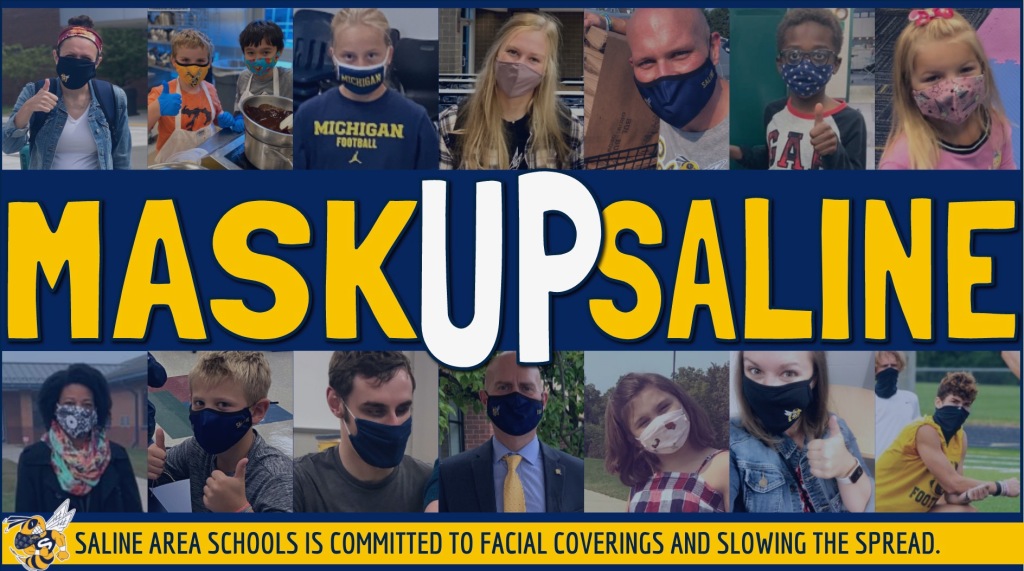
Saline Community,
We are continuing to require masks as outlined in our Preparedness and Response Plan, along with our Connected Learning Plan.
Thank you for your continued support and cooperation!
Scot Graden
Hybrid Schedule Update
(This message was sent to all Saline Area Schools families on 10/5)

SAS Families,
I hope your family is settling into the “new normal” that exists for your student, whatever that may look like. Our staff has worked tirelessly to provide the best education possible to all students, regardless of the delivery platform. Their efforts should be acknowledged and praised given the circumstances. Our students and families have responded with resilience and have shown a tremendous ability to adapt.
Virtual families are experiencing a distance-learning model unlike any we have ever seen before. This innovative approach, borne out of necessity, allows students opportunities to learn in both asynchronous (self-paced assignments) and synchronous (everyone learning together) formats.
For our hybrid families, students started in-person instruction last week. Our COVID-19 mitigation strategies allow each student two days of face-to-face learning with smaller class sizes, safe transportation, social distancing and mask wearing.
Our original published timeline indicated our hope to begin full, in-person instruction on Monday, October 12th. However, given local conditions and internal metrics, we will be extending our hybrid format another two weeks. An updated timeline for your reference is below:
- Week of October 5th: Hybrid student schedule is Blue/Gold/Blue/Gold/Async
- Week of October 12th: Hybrid student schedule is Blue/Gold/Blue/Gold/Async
- Week of October 19th: Hybrid student schedule is Blue/Gold/Blue/Gold/Async. **On Monday, SAS Administration announces intended schedule for October 26th and the weeks following
- Week of October 26th: TBD
Please attend (or watch live on Facebook) the next Board of Education meeting on Tuesday, October 13th at 6:30 p.m. at Liberty School. I will be providing the community instructional model updates on a regular basis as more information becomes available.
Your flexibility has allowed us to evaluate our systems and plan for the coming trimesters. We will seek additional feedback from you (via survey) in mid to late October. Thank you for your continued patience and support.
Sincerely,
Scot Graden
Superintendent
New Hybrid Schedule
(This message was sent to all Saline Area Schools families on 9/22)
SAS Community,
We have been closely monitoring a number of COVID-19 community metrics as it relates to our local conditions for a safe return to in-person learning. The latest Washtenaw County metrics put us in a position to begin hybrid in-person instruction on our originally targeted date of September 28th, 2020. However, the schedule has changed slightly. Please read through the message below.
Covid-19 Health Committee
In making this decision, we worked with representatives from our staff groups, along with Karan Hervey, our district nurse. We used the following metric guides (as suggested by top public health officials across Washtenaw County) to help us make this determination:
| % of positive tests over the last 7 days | Number of cases per 100,000 residents | % increase or decrease in total cases over last 7 days | Anecdotal evidence of general compliance |
In referring to Governor Whitmer’s Roadmap, we are currently in Phase 4 in Washtenaw County (see page 21). In order to prepare for hybrid/in-person instruction, SAS has been working diligently to:
| Clean Buildings | Prepare PPE for Staff | Install Traffic Flow Signs | Plan Health Procedures |
| Prepare Food Service | Organize Bus Fleet | Staff Prof. Development | Determine Class Rosters |
Timeline of Upcoming Events
- September 28: SAS begins hybrid/in-person instruction for a two week span
- Week of September 28th: Monitor the students/staff and implementation of hybrid model
- October 5: Covid-19 Health Committee reviews implementation plan
- Week of October 5th: Determine next steps and communicate to SAS community
New Hybrid Schedule
Over the course of these last few weeks of virtual learning and with the anticipation of a return to hybrid/in-person, we are recognizing the need to adjust our hybrid schedule to better meet the academic needs of our students. Please review the new schedule below:

As noted, students assigned to “BLUE” will be in-person Mondays and Wednesdays. Students assigned to “GOLD” will be in-person Tuesdays and Thursdays. All students will be remote on Fridays (and provided instruction virtually).
We recognize that making this change to the New Hybrid Schedule may present a hardship for some families as it relates to childcare and other scheduling issues. We apologize for this, yet we are realizing that the Pandemic continues to present many challenges to the school district as a whole which are requiring us to adjust and become more flexible through the process.
School is Different Now
As much as we have tried to create a schedule for teaching and learning that replicates what students, parents and teachers have grown accustomed to over the years, school is different now. We must be creative as we develop flexible instructional approaches that will still allow our students to get a strong education.
Our priority is to keep our students and staff safe. Additionally, we want to develop the best possible instructional models given the circumstances. We are confident that with this instructional plan, we will be doing just that, providing a safe learning environment, allowing families/students options for their instructional model and providing the proper time and support to our teaching staff to deliver quality instruction.
Next Steps
For those students (families) who are planning to return to hybrid/in-person instruction next week, you will be receiving back-to-school instructional information from your building principal later this week that outlines the important safety procedures to follow. For those students staying on an all virtual instructional model, you will receive continued instructional support from your current teachers.
As mentioned, please anticipate another update during the week of October 5th, 2020. We appreciate your outstanding support and continued flexibility.
In Partnership,
Scot A. Graden
Relationships & Marie Kondo

The last ten days have me thinking about some basic needs for September. September means the start of a new school year. This September is different. I am not talking about safety protocols or return to school roadmaps or anything specific to the COVID-19 global pandemic. In general, I am referring to the philosophical foundations of how we think about the school year’s start. This school year begins with constraints that no one wants.
Relationships are the foundation of any school. The trust that evolves between teachers and students inspires learners to do their work; it enables teachers to give critical feedback and energizes educators to find ways to unlock student potential. Unless students feel safe and supported, meaning each child has established a relationship with an educator, academic progress slows. Too often, and unfortunately, those relationships take a back seat as prioritizing academic gains takes precedence. This year, perhaps more than any other, building strong connections with students must be at the forefront of all we do. Encouraged by the “Meet and Greet” activities at the elementary schools this week, it is evident that our teachers also realize the importance of establishing critical relationships both safely and early. This year’s challenge is that much of the early relationship-building begins through distance learning.
Since March 13, when the schools closed due to the COVID-19 global pandemic, students (and staff!) have missed school-based social, emotional, and academic opportunities. The research is definitive that, “When kids spend their daytime hours in safe, supportive schools where adults work every day to build strong relationships with every student, they are simply better, more engaged learners.” (Gonser, Edutopia 2020) With little effort, one can glean numerous resources suggesting activities that teachers can employ remotely. A quick look at Twitter and Instagram feeds shows teachers experimenting and implementing relationship-building using technology. When in-person instruction ceases, then technology and some old-school methods will help educators foster relationships and connect with each child in a meaningful way.
This list, from Edutopia, is good, but certainly not exhaustive. Something as simple as sending a postcard through the US Postal Service is as meaningful as that first in-person Meet and Greet. What child doesn’t feel honored when receiving mail addressed personally to that child? We learned many things during the Spring about remote learning. How we take that knowledge and further adapt it to focus on forging relationships is a work in progress. “We’re in the middle of a grand experiment here,” said Mike Magee, the CEO of Chiefs for Change, a nonprofit whose members lead education systems serving 14,000 schools. “We’re going to find out a lot about the degree to which relationships can be built online between teachers and students.” (Rauf, Education Week 2020) I am confident that the educators in Saline will prioritize this aspect of the virtual classroom and find ways to make every child feel welcome, acknowledged, and supported.
Next, it’s important to acknowledge that we are experiencing events that will shape and define us. We are conscious of the pandemic’s hardships on students, staff, families, and businesses. To that end, the degree to which we “Marie Kondo” the start of the school year will ultimately determine our success. Marie Kondo rose to fame in the US in 2019, touting organizational methods and techniques to minimize clutter and actualize the human experience. She advocates removing from one’s life things that do not spark joy. This mantra simplifies the education system, yet the premise is germane. In approaching the 2020-2021 school year, staff and community members must share priorities essential to student well-being (first) and student achievement. In so doing, the human connection becomes paramount.
Gonser, Sarah. “7 Ways to Maintain Relationships During Your School Closure.” Edutopia, George Lucas Educational Foundation, March 25. 2020, www.edutopia.org/article/7-ways-maintain-relationships-during-your-school-closure
Rauf, David Saleh. “Nurturing Teacher-Student Connections in a Virtual World.” Education Week, July 30, 2020, www.edweek.org/ew/articles/2020/07/23/nurturing-remote-learning-relationships.html.
SAS Community Update | August 28, 2020
Friday, August 28, 2020
Saline Area Schools Community,
We are quickly approaching the starting line of the 2020-2021 school year, which will be unlike any we have experienced before. Our staff continues to dedicate time to meet each child’s academic, social and emotional needs both in and out of the classroom. Our Board of Education, Foundation for Saline Area Schools and district leadership are committed to providing students with the necessary tools to ensure success. We are all busy navigating uncharted waters to prepare our buildings and resources for an unusual return. I want to take this opportunity to update you on a few important items:
Survey + Connected Learning Plan
Thank you to all SAS families who participated in the Opening of Schools Feedback Survey that was collected in early August.Your submissions, feedback, suggestions and most importantly patience and flexibility were key contributors to building the Connected Learning Plan.
Welcome Week
The first day of the school year for SAS students has been moved to Tuesday, September 8, 2020. Therefore, next week (August 31 – September 3, 2020) will be treated as “Welcome Week” for SAS families. You will receive daily communication from your building leaders with information relative to staff introductions, building tours, food service, technology, student schedules, and various tips and tricks to help navigate learning this year.
Learning Models
As of today, our Learning Model Timeline is still accurate. Reminder, for the first three weeks all students will participate in 100% distance learning. Once we open the hybrid window (if local conditions allow), our staff will remain committed to providing a robust learning environment for both distance and in-person learners.
Health + Safety
On Monday, I had the honor of hosting Dr. Varsha Moudgal (Infectious Disease Specialist, IHA Health) in a Facebook Live Q&A session. Dr. Moudgal presented valuable information specific to our community and commended our staff for the details outlined in the Connected Learning Plan and our strategic timeline for reentry. To view her presentation and watch the session, click HERE under “Presentations.”
Equity for all Students
The COVID-19 Pandemic has visibly displayed some serious inequities across our country. This is a stern reminder that Saline Area Schools needs to continue to invest significant time, energy and commitment to creating a more diverse, equitable and inclusive environment for ALL our students. We have been working hard in this area over the summer which has culminated in an outstanding day of professional development on August 27th that involved equity training for 450 SAS staff members.
Student Class Placements at the Elementary Level
As many of you are getting class placements at the elementary level this week, there are a few important considerations that we want to share with all of you. First, we worked very hard to try and meet the needs of the students (families) in our district. That meant combining some students from all three of the lower elementary schools (Harvest, Pleasant Ridge and Woodland Meadows) who requested a virtual class placement for the first trimester to make a full class of students with a virtual only teacher.. In addition, in order to meet the safety needs of the eventual hybrid in-person classes and to keep our class sizes lower for in-person instruction, we have some virtual classes that are higher in class size than the in-person classes. Again, we are trying our best to create the best possible learning environment that meets the safety and educational needs of all our students and families. This has meant making adjustments with our instructional model in the midst of this COVID-19 Pandemic.
The strong sense of community that radiates in Saline will continue to carry us through the complications of the pandemic. As we all make the final preparations for the coming school year, let’s offer each other support and understanding on behalf of our remarkable students and their voyage through the coming months.
In partnership,
Scot A. Graden
Superintendent

Global Pandemic, Not a Global Panic

We are in mid-August and preparing to return to school. We are also in the midst of a global pandemic, making this return to school unlike any we’ve experienced. There are so many questions, and for most of those questions, the answers change daily.
- What is safe?
- Are masks necessary?
- How often should we insist upon hand-washing and cleaning of classrooms?
- How will I know if it is safe to send my child to school?
- What should I do if my child is symptomatic?
- Why doesn’t the school take my child’s temperature each day?
From March 13, the date schools shuttered for the remainder of the school year, the catchphrase, “We are in this together,” promotes reassurance and trust. As we prepare to re-open the school buildings, that catchphrase has become even more critical. Navigating this new landscape of teaching and learning calls upon ALL of us at home, at school, and in the community to adapt quickly to new safety protocols and new learning spaces. Following the guidance from the Center for Disease Control (CDC), the Washtenaw County Health Department, and the Michigan School Code, we can be reasonably assured that the school buildings are ready and staff is prepared to welcome students into the schools. That guidance, however, is limiting.
Schools cannot randomly or arbitrarily give physical examinations to students. The Michigan School Code, section 380.1504, asserts that schools may not conduct compulsory physical examinations; this includes mandatory temperature checks. The school will continue assessing students that are ill, including taking the child’s temperature.
Families, we need your help. Families must assess each student’s well-being each morning before the child comes to school. Governor Whitmer’s Michigan Safe Schools Roadmap, released on June 30, 2020, recommends that families check each child’s temperature daily at home before school. (p.24) The presence of a fever higher than 100.4o Fahrenheit or the child is symptomatic (cough, shortness of breath) should prompt the family to keep the child at home and follow up with the family physician.
The recommendations from the CDC echo those found in the Governor’s Roadmap.
- CDC does not currently recommend that schools conduct universal symptom screenings (screening all students grades K-12)
- Parents or caregivers are strongly encouraged to monitor their children for signs of infectious illness every day.
- Students who are sick should not attend school in-person.
Working together with families, a safe return to school is possible. Community members also help control the spread of the novel virus COVID-19 by wearing masks, avoiding large gatherings, and closely monitoring personal health. We are in this together, and together, we will safely return our children and staff members to school.
SAS Reopening Survey Results

We recently (August 6-9) surveyed our families and staff related to the learning format they preferred for the start of the 2020-2021 school year.
Click here to see the results & the presentation made to the Saline Board of Education on August 11th.
The presentation and all other COVID related school opening information can be found on the Saline Area Schools Return to Learn page.
Return to Learn Information
As of this morning, the survey has been sent to parents and teachers related to their desire for learning (or teaching) models to start the 20/21 school year.
Click here for the “Return to Learn” page on our district website that has more information and the presentation about the plans. This page will be updated frequently as we add new information based on community feedback.


 Scot Graden's Blog